

FEATURED PUBLICATIONS
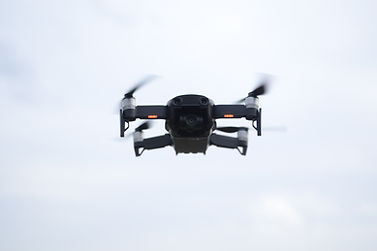
Unmanned aerial vehicles – better known as drones – have been around for decades. However, it is only in recent times that they have begun to revolutionise sectors such as agriculture and logistics.
The technology’s potential is clear: the global market is projected to reach $58.4 billion by 2026.
In the GCC, the market is expected to reach $1.86 billion. This trend is being fuelled by both private use and applications within business and industry.
Drone technology will power the Gulf’s fourth industrial revolution


“The National Space Strategy is progressing quickly, and I anticipate large-scale projects in the near future,” said Alex Cresniov.
“The programme has the potential to turn the country into a regional hub for commercial space activities as well as a sophisticated research and development centre."
“The UAE Mars Mission clearly shows that other parts of the world are capable and space-ready, too.”
Space tech gives Gulf nations a launchpad for local talent
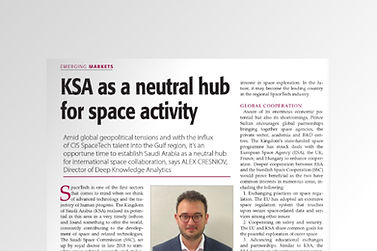
Amid global geopolitical tensions and with the influx of CIS SpaceTehc talent into the Gulf region, it's an opportune time to establish Saudi Arabia as a neutral hub for international space collaboration, says Alex Cresniov, Director of Deep Knowledge Analytics.
SpaceTech is one of the first sectors that comes to mind when we think of advanced technology and the trajectory of human progress. The Kingdom of Saudi Arabia (KSA) realised its potential and found something to offer the world.
KSA as a neutral hub for space activity


"A Joint GCC Space Agency would enable R&D consolidation, cost sharing, independence from the global space community, and creation of a SpaceTech fund and accelerator," - Alex Cresniov, Director of Deep Knowledge Analytics.
Outer space will eventually be governed by the same geopolitical policies that exist here on Earth.
Resource-pooling key for GCC to make headway in commercial satellite sector


Saudi Arabia and the UAE stand out as the most advanced within the regional space race based on satellite launches, geospatial intelligence, and SpaceTech R&D. The two allocate the largest resources to space projects compared to their Gulf counterparts.
Saudi Arabia’s interest in space has grown significantly thanks to the King Abdulaziz City for Sciences and Technology (KACST) and the Saudi Space Commission (SSC).
Gulf nations will benefit from a combined race to space initiatives


Currently, UAE families take most of the responsobility for caring their elderly. The shift from the extended family model towards smaller nuclear families and the lack of sufficient old-age care facilities will pose challenges that can exacerbate the burden of old-age care. These evolving social dynamics and infrastructural limitations will also have an impact on the healthcare sector and the national economy.
Emerging longevity sector a steppingstone to social inclusion for old-age people in the UAE


Alexei Cresniov, Director of Deep Knowledge Analytics, said: “The UAE government remains committed to continuously strategising and improving the quality of its healthcare system. National policies and local programs have been strengthening the country’s position as a hub for pharmaceuticals, medical research, development centres, and now longevity.”
UAE sets a precedent for region’s longevity sector

SpaceTech companies are among the 16 startups chosen as part of the 2021 cohort of Hub71, Abu Dhabi’s global tech ecosystem.
The UAE has been making concerted efforts to secure a front-row seat in the global Space Race. The nation has enhanced its strategic assets and position within the space sector, including space exploration, satellite communications, space technologies and their secondary applications here on Earth—from SpaceTechs supporting the SDGs and enabling connectivity, to those promoting responsible business and enhancing global security.
As UAE’s space sector grows in stature, SpaceTech fund and accelerator are natural next steps


Most developed nations, including the US, UK, Australia, South Korea, Japan and Germany, have more elderly people than young populations. In contrast, the UAE population is quite young, with a median age of 32.6 in 2020. During the same year, the median age in Germany and Japan was 45.7 and 48.4, respectively. Longevity trends in the UAE are evolving. Life expectancy at birth was 76.15 years in 2009. In 2019, it reached 77.97 years. This uptick in the aging population is set to trigger considerable changes within the healthcare system.
Emerging longevity sector a steppingstone to social inclusion for old-age people in the UAE
.jpeg)
Cities that ranked high on the list tended to act early and swiftly, said Cresniov.
Countries with response plans in place due to recent health crises — such as Singapore, South Korea and the United Arab Emirates — were better prepared, according to the report. Italy, in contrast, had a pandemic plan but failed to implement it, Cresniov said.
How well did your city respond to Covid? A new ranking has answers
.png)

Alexei Cresniov, Director of Deep Knowledge Analytics, said: “At Deep Knowledge Group, we recognise the importance of strong government buy-in to utilise our tech-enabled data and analytics tools in advancing their knowledge-based economy.
“Owing to the vision and wise leadership of governments such as the UAE, we continue to expand our operations in the GCC region and globally, serving as the backbone of a solid knowledge economy. We look forward to helping more public and private sector entities across the wider MENA region in enhancing their knowledge economies.”
2022 is the year the UAE writes the next chapter of its knowledge economy
_edited.jpg)
Traditionally, retirees from prosperous countries have usually chosen to relocate to regions with favorable weather and affordable, enjoyable lifestyles. Among the key factors that make such regions attractive are their relatively inexpensive healthcare systems and other cost savings combined with their high standards of living.
Savvy Caribbean and Central American countries offer perks to attract expat retirees.
Longevity-Progressive Countries – Retirement Destinations of the Future?
.png)

As 2021 commences, global tourism remains at a virtual standstill owing to the pandemic, with any hope for a recovery dashed by the new Covid-19 variants that emerged in late December. When it comes to travel freedom, the pandemic has somewhat leveled the playing field, albeit temporarily. For developed and developing nations alike, limited human mobility around the world is currently not only the result of a lack of social freedom or poor economic development but also a failure of risk management, health readiness, and monitoring and detection.
Covid-19 and the Recovery of Mobility – Economics, Migration, and Governance